 Photos - Patrick Boland
Is there something in the Aussie sense of humour that is particularly well-suited to the genre of farce? Is it our casually anti-authoritarian skepticism towards politicians and their ilk? Having attended many excellent local farces over the years I’m inclined to say “yes”. In particular, there seems to be a distinct brand of humour amongst the Generation X/Gen Y demographic that embraces a rough-hewn, deeply ironic (post-ironic?), and self-deprecating style of comedy that revels in self-conscious awkwardness and particularly highlights vanity, ineptitude and insecurity. And yet there is something oddly celebratory about it compared to the vicious undertone of more traditional social satire, a kind of inclusiveness (or is it just a mutation of our Tall Poppy Syndrome?) that suggests we are all flawed, embarrassing and, as a result, worth poking fun at. If interpreting this as some kind of subliminal clarion call to embrace your inner dickhead might be reading a bit much into things, there is nevertheless clearly a message that you shouldn’t take yourself too seriously… much less anyone else.
All this, in a roundabout sort of way, brings us to The Suicide. Although there is nothing in this production that overtly “Australianises” the 1928 Russian satire, it remains an unmistakably local approach to the text, infused throughout with the aforementioned style of irreverent, deliberately gauche idiocy, shifting the play squarely into the realm of farce. The story concerns Semyon Semyonovich, a self-centered manchild, depressed at being unemployed and relying on his wife’s income as a cleaner, who decides it’s all too much and that suicide is his best recourse. Before he can pull the trigger, however, Semyon is approached by a slick agent who offers to secure him a fortune to leave behind for his family in exchange for the naming rights to his suicide note, allowing him to die as a “heroic” provider.
Delighted by this sudden illusion of importance, Semyon listens to a series of presentations from various corporate interests and lobby groups who entice him to die in the name of their respective causes, each pitch more absurd than the last. Yet while his sense of celebrity balloons out of control, Semyon’s cowardice starts to overtake his ego, beginning to doubt whether he can actually go through with his now contracted suicide.
While modernised and still set in Russia, writer/director Simon Stone’s adaptation of Nikolai Erdman’s original text wisely avoids overloading the play with gratuitous modern references, confining them mostly to those sponsors seeking to secure the suicide note endorsement, and even these are fairly general, befitting the broad tone of the farce. Indeed, looking at the finished product it is hard to say what exactly is from Stone’s script and what has been playbuilt in the rehearsal process, with its dialogue and action often feeling improvised.
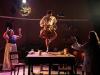
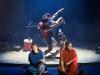
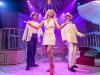
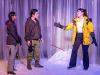
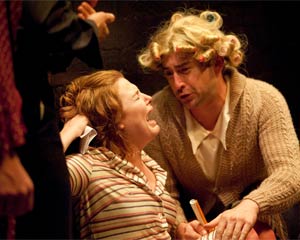
In any case, the resulting show is energetic to the point of near anarchy, its breakneck pace and wild stagecraft both creative and unpredictable. The entire performance area is covered with loose gravel which haphazardly flies around as the actors scream and wrestle their way through their chaotic scenes, gradually coating the front rows in a film of dust. Rapid-fire costume changes and a lot of doubling melds with occasional audience interaction, contributing to an open metatheatricality where the fourth wall topples pretty early on. Although affecting a rough and riotous production style, beneath the surface lies a quite a slick, well-conceived piece of theatre, presented by an enthusiastic and talented group.
If any criticism at all could be laid at the feet of this rendition of The Suicide, it would be that it is almost too hilarious, being so committed to being as unrelentingly funny as possible that perhaps the actual point of the story gets a little lost. Certainly, the fleeting instances where some actual seriousness is striven for fall flat, and being a social satire rather than straightforward comedy there is a requirement that a message of sorts be imparted. While the central conceit that a bunch of lobbyists and corporations would be so crass as to bid for publicity in a man’s suicide note comes through loud and clear, it tapers off fairly quickly as a great deal more time is spent on lampooning the central character than those seeking to exploit him.
Although admittedly unfamiliar with the original text, I couldn’t help but wonder if the Semyon role was originally less dominant, or at least less extreme in its characterisation, more of a mirror for the foolishness of the other personalities than a figure of such intense folly himself.
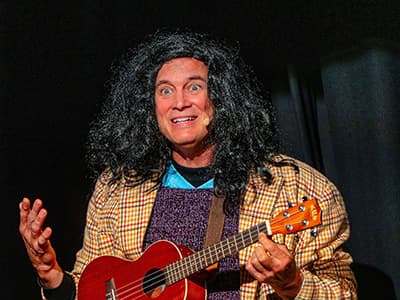
A lot of this seems to come down to the explosive performance of Gareth Davies in the part, perhaps the epitome of the aforementioned self-mocking Gen Y style of maladroit egotism. Whether the character’s selfishness and repeated blunders strike you as consistently amusing or you find his petulant flouncing cumulatively grating is a matter of taste, but there is no denying that Davies is a veritable comedic dynamo, his manic energy levels driving the show even though well supported by the rest of the talented cast. Perhaps if Davies and his frenetic shtick could have been reigned in a little, the “message” of the play would not have been so sidelined, but it would have undoubtedly been less side-splitting as a result. Whether the need to be funny trumps the need to make a thematic point resonate is something worth considering.
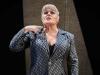
The entire cast was similarly uproarious, and particular plaudits go to Tom Wren in a variety of “straight man” roles, stoically keeping a straight face while other characters descend into hysteria around him, and also Anne-Louise Sarks (primarily as Semyon’s long-suffering wife Maria), whose impeccable timing and expressive performance were on the perfect comedic wavelength for farce, and would likely be marvelous in the classics of Fo, Gogol or Molière.
The Hayloft Project’s fresh, exciting new take of The Suicide may occasionally veer towards overindulging its particular brand of humour at the expense of its narrative, but is nevertheless a relentlessly entertaining piece of theatre. We can only hope to see more productions as engaging as this one.
The Hayloft Project in association with B Sharp present
The Suicide
by Nikolai Erdman
A New Version By Simon Stone
Directed by Simon Stone
Venue: Belvoir St Downstairs Theatre, 25 Belvoir St, Surry Hills
Dates: Thursday 18 March – Sunday 11 April, 2010
Times: Tues 7pm, Wed-Sat 8.15pm, Sun 5.15pm
Tickets: $32 / $24
Bookings: 9699 3444 or www.belvoir.com.au